Although geomancy has been popular for millennia around the world, in the Western world it was widely practised during the Middle Ages and the Renaissance but then its popularity died down until a recent small resurgence in interest. An offshoot of geomancy became Napoleon's Book of Fate.
Many see this form of divination as too "simplistic" but its outward simplicity belies the depth of the answers it gives. Some use it to derive a single figure as an answer. Others prefer to combine it with astrology. Each figure has an association with a planet and an astrological sign. The figures are placed within a square Medieval astrological chart and interpreted according to which houses they fall in. This chart is sometimes called a "theme".
The names given to the four lines of a geomantic figure, from top to bottom, are:
Head
Neck
Body
Feet
In France these lines are often called the Head, Chest (or Heart), Belly and Feet.
The figure is usually represented using centered points (dots on paper, holes in the sand). However there are some historical variations. In Medieval times, the dots were sometimes printed justified to the right which looks very disconcerting when you are not used to seeing them this way. Especially if you associate a mnemonic image with the figure, for example, two cups for Acqusitio (below). Arabic geomancers often wrote a line in place of two dots, as is used in Arabic handwriting.
There are classic associations linking the figures to planets and astrological signs dating from the Middle Ages as well as the associations developed by Agrippa in the Renaissance. Agrippa calculates the Nieces (Nephews) differently from the classic way and places the figures into different houses. Many modern geomancers use this Renaissance model.
Visit my
Geomancy reading page to get a quick geomantic spread done for you with an interpretation, or continue reading to learn the process yourself.
You can also directly to the meanings of the geomantic figures below.
Are you ready to consult the Oracle of the Earth?
First, you need to decide on a way of getting a one/two response. Use either a Roman dice (two-sided, bone and male), a coin (Heads in one point, Tails is two points) or a randomly drawn line of dots (usually right to left in the Arabic way) which gives an either odd or even answer. In Ramal Shastra (India) four dice on a rod are used. You can also use a bag of seeds or small pebbles. With this method you grab a handful and remove the seeds two at a time from the pile until only 1 or 2 are left.
To start you need four one/two answers to draw a figure. For example, a result
of two, two, one, one (even, even, odd, odd) gives the figure Fortuna Major.
Continue until you have four geomantic figures. These are the four Mothers or Matres.
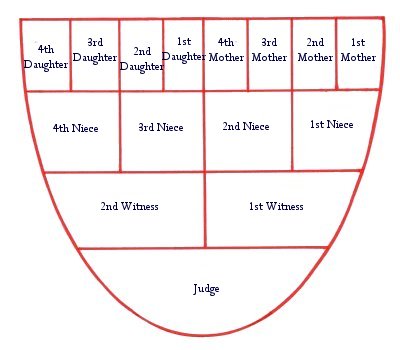
The next step is to create the four Daughters or Filiae. Simply use the top lines ("the heads") of each of the Mothers to create the first Daughter. For example, if the top lines of each of the Mothers is two, two, one, two, then the First Daughter will be the figure Albus, two, two, one, two.
The Second Daughter uses the second lines ("the necks") of each of the Mothers. The Third Daughter is made up of the third lines ("the bodies") of each of the Mothers. The Fourth Daughter comprises the fourth lines ("the feet") of each of the Mothers.
Now it gets a little different. The next line of four figures is called the four Nieces or Neptes. Some modern books call them the four Nephews.
The First Niece is made by adding the corresponding points of the first two
Mothers and coming to an odd or even result. Odd is one point, even is two points. So if the first two Mothers have top lines ("heads") of two points and one point, then the first line of the First Niece will be one point. If the first two Mothers have second lines ("necks") of one point and one point, then the second line of the First Niece will be two points. And so on.
In a nutshell...
one point + one point = two points
one point + two points = one point
two points + two points = two points
The Second Niece is made by adding the points of the last Second and Third Mothers. The Third Niece is made by adding the points of the first two Daughters. The Fourth Niece is made by adding the points of the last two Daughters. Now there should be 12 figures in three rows.
The fourth row is made up of two Witnesses or Testes. The First Witness or the Right Witness is made by adding the first two Nieces together. The First Witness reveals the question's past. The First Witness has also been called Past Testimony or the Father of the Judge.
The Second Witness or the Left Witness is made by adding the last two Nieces together. The Second Witness reveals the question's future. The Second witness has also been called Future Testimony or the Mother of the Judge.
The last row has one single figure, the Judge or Iudex (Judex), made by adding the two Witnesses together. The Judge is the synthesis of the reading and reveals the Outcome of the question.
Only one of eight figures will ever end up as the Judge: Acquisitio, Amissio, Conjunctio, Carcer, Fortuna Major, Fortuna Minor, Populus and Via.
Now for interpreting the Final Outcome:
Good Judge + good Witnesses = Excellent Outcome.
Bad Judge + bad Witnesses = Bad Outcome.
Good Judge + bad Witnesses = Success after delays and problems.
Bad Judge + good Witnesses = No real or enduring success.
Place the geomantic figures you have created into the Geomantic Shield as shown below. If you wish to use Houses in the Shield, the 1st House is in the top right hand box (First Mother) and the Houses follow to the left, and finish with the 12th House where the Second Niece is placed.
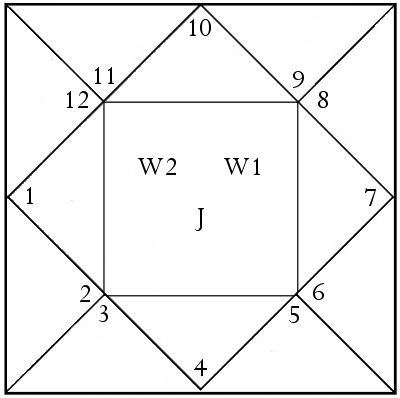
Or place the geomantic figures you have created into the Geomantic Horoscope as shown below.
Agrippa (1655) places the figures in different houses to these. The Mothers go into the 1st, 10th, 7th and 4th Houses (the angular houses). The Daughters go into the 2nd, 11th, 8th and 5th Houses (the succedent houses). The Nephews (Nieces) go into the 3rd, 7th, 9th and 6th Houses (the cadent houses).
Some consider that if a figure occurs four times or more, then the reading is considered void. Others state that if Rubeus or Cauda Draconis falls in the 1st house then the reading is not fit for judgement and should be immediately abandoned for a few hours, or even that day.
More Advanced Techniques
Go to More Advanced Geomantic Techniques including The Reconciler, The Way Of the Points, the Part of Fortune, The Projection of Points, the Qualities, the Four Triplicities, Occupation, Conjunction, Mutation, Translation, Astrological aspects, the Company of Houses, and what to do if the Reading makes no sense at all.
VIA (THE WAY) Change. Also: Iter. This figure signifies a journey, action and forward movement. There is an element of loneliness connected with this figure as well as a sense of slowness or delay. This figure is generally unfavourable unless the question is about travel or progress. Life. Guide. Associations: Mobile, Moon, Cancer, Monday, Water, Stomach
POPULUS (THE PEOPLE) Stability. This neutral figure denotes family, friends, group involvement and generally indicates that the outcome depends on others. It can also mean messages and news as well as the environment around us. Going with the flow. Associations: Stable, Moon, Cancer, Monday, Water, Breasts and Midriff
CONJUNCTIO (UNION) Interaction. This figure signifies love, friendship, sexual attraction, contracts, agreements and partnerships. Combination of forces for good or bad, a neutral figure. It also indicates the recovery of lost objects. Associations: Mobile, Mercury, Virgo, Wednesday, Earth, Intestines and the Belly
CARCER (PRISON) Isolation. Confinement, limitations and restrictions Delays and reversals of fortune. Good for contracts and mortgages etc. Servitude and the need to accept the situation as it is. Mostly unfavourable unless the issue is about stability or security. Willpower. Associations: Stable, Saturn, Capricorn, Saturday, Earth, Knees and Lower Legs
FORTUNA MAJOR (GREATER FORTUNE) Power. Success, good luck, great fortune, celebration, property and possessions. Honour and respect. Associations: Stable, Sun, Leo, Sunday, Fire, Heart and Chest
FORTUNA MINOR (THE LESSER FORTUNE) Swiftness. Smaller good fortune, assistance from others, influence, protection from misfortune and harm. Abuse of power. You may have to work hard but success is yours. Change and instability. Quick outcome. Associations: Mobile, Sun, Leo, Sunday, Air, the Spine
ACQUISITIO (GAIN) Prosperity, promotion, benefit, gains from business or extension of existing property. Worldly success. Your difficulties are now behind you. Something is within one's grasp. Associations: Stable, Jupiter, Sagittarius (Agrippa: Pisces), Thursday, Fire, Hips and Thighs
AMISSIO (LOSS) Loss of money, sometimes loss of love. Things lost or taken away, illness, theft, financial problems. Negative outcome. However, if you wish to lose something (weight etc), you will be successful. Associations: Mobile, Venus, Taurus (Agrippa: Libra), Wednesday, Earth, Neck and Throat
LAETITIA (JOY) Joy, laughter, happiness, good luck, delight, beauty, good health, harmony and peace of mind. Favourable for almost everything. A secret is revealed. Agreement. Associations: Mobile, Jupiter, Pisces (Agrippa: Sagittarius), Thursday, Water, Feet
TRISTITIA (SADNESS) Unexpected disappointment, sadness, humiliation, loneliness, change for the worse. Loss and destruction of something that has been carefully built up. Illness. Pain. Unfavourable unless the issue involves building and the Earth. A secret is kept. Associations: Stable, Saturn, Aquarius, Saturday, Air, Ankles
ALBUS (WHITE) Peace. Illumination, wisdom, good results in business through moderation and careful decisions. Spiritual growth and harmony. Patience, thoughtfulness and the ability to balance all areas of life. Good for beginnings and profit. Favourable but weak. Sleep, slow down. Ice, snow. Associations: Stable, Mercury, Gemini, Friday, Air, Shoulders and Lungs
RUBEUS (RED) Passion. Vice, temper. Sexuality. This is a warning for caution and a need for retreat. Negativity and upheaval. Stop and listen to your inner voice to find the correct path to follow. Good in all that is evil, and evil in all that is good. Associations: Mobile, Mars, Scorpio, Tuesday, Water, Genitals and Reproductive System
PUELLA (GIRL) Harmony. Girl, lady, purity, cleanliness, external appearances, including superficiality, indecisiveness and fickleness. Good relationships with women. Healing and nurturing. Music and the arts. Passivity. Associations: Stable, Venus, Libra (Agrippa: Taurus), Friday, Air, Kidneys and Lower Back
PUER (BOY) Strife. Young man, men, employee. Rashness and combativeness. Violence. Traditionally good for love and war, but negative for other matters. Great energy that needs to be harnessed. Intiative and leadership. Impulsive behaviour. Associations: Mobile, Mars, Aries, Tuesday, Fire, the Head
CAPUT DRACONIS (DRAGON'S HEAD) Beginning. A place of entry. New starts, birth and innocence. Alertness and shrewdness. Profit. Both favourable and unfavourable (mixed). Introversion, mysticism. Associations: Stable, North Node of the Moon, Thursday, Earth, Right Arm
CAUDA DRACONIS (DRAGON'S TAIL) Ending. An exit, a way out. Bad luck, a downward path, death and endings. Evil. You need to walk away from something and start anew. Good in all that is evil, and evil in all that is good. Illusion, fraud, deception. Associations: Mobile, South Node of the Moon, Saturday, Fire, Left Arm
The Houses
House
Name
Translation
Meaning
1st House
Vita
Life
The querent. Personal life and appearance, beginnings, accidents, new projects, length of life. East. Angular.
2nd House
Lucrum
Riches
Finances, values, lost or stolen objects, possessions, potential poverty or wealth, resources, material things desired, business transactions, earnings (work). East North-East. Succedent.
3rd House
Fratres
Brothers
Siblings, relatives, neighbours. Short journeys. Schooling, early education. Cars. Personal communication, letters, emails, advice. Gossip, rumours, news. North North-East. Cadent.
4th House
Genitor
Father
Home, parents, father, domestic issues, buried treasure, land, real estate, inheritances from parents, houses, farms, agriculture, old age, mines. The end of any matter. North. Angular.
5th House
Nati
Sons
Children, women, luxury, affairs, gambling, hobbies, stocks, romance, pregnancy, elections, entertainment, feasts, eating, drinking, parties, fun. Personal creativity. Bodies of water, rain. Teaching. North North-west. Succedent.
6th House
Valetudo
Health
Health, illness, diseases, injuries, misfortunes. Hygiene, healing. Daily work, daily routines. Pets, small animals. Servants, employees. West North-west. Cadent.
7th House
Uxor
Wife
Partner (marriage and business), lover. Divorce, lawsuits, contracts. Quarrels, open rivals, competitors. Thieves, robbers, dishonours. Any unidentified person. The astrologer. West. Angular.
8th House
Mors
Death
Shared resources, death, birth. Surgery. Transformations, occult. Taxes, debts, mortgages and loans. Legacies, inheritance from other than parents, other people's money or resources, corporate money. Investigations. Poverty, suffering, dangers. Sleep. West South-West. Succedent.
9th House
Itineris
Journeys
Long-distance travel, religion, philosophy, education, learning, religion. Lawyers, professionals. Dreams, divination. Wisdom. The arts. Public communication, media, publishing. South South-West. Cadent.
Friends, sources of help. Protection, riches, presents. good fortune, Joy, hopes and wishes, praise, confidence, goals. Social activities, group endeavours. South South-East. Succedent.
12th House
Carcer
Prison
Loss, imprisonment, secret enemies. REtreat and solitude. Widowhood, fears. Secrets, suffering, afflictions. Large animals. Hidden life, unconscious thoughts. Institutions, hospitalisation. Suicide, murder. Vagabonds, prostitues, beggars. Charity. Drugs and alcohol. South South-West. Cadent.




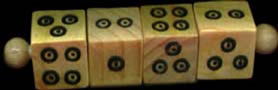 First, you need to decide on a way of getting a one/two response. Use either a Roman dice (two-sided, bone and male), a coin (Heads in one point, Tails is two points) or a randomly drawn line of dots (usually right to left in the Arabic way) which gives an either odd or even answer. In Ramal Shastra (India) four dice on a rod are used. You can also use a bag of seeds or small pebbles. With this method you grab a handful and remove the seeds two at a time from the pile until only 1 or 2 are left.